Department of Information Technology, Institute of Medicine Hosts a Program on 'The Augmented Clinician: Integrating AI into Clinical & Academic Workflows as a part of Digital Literacy for Clinicians
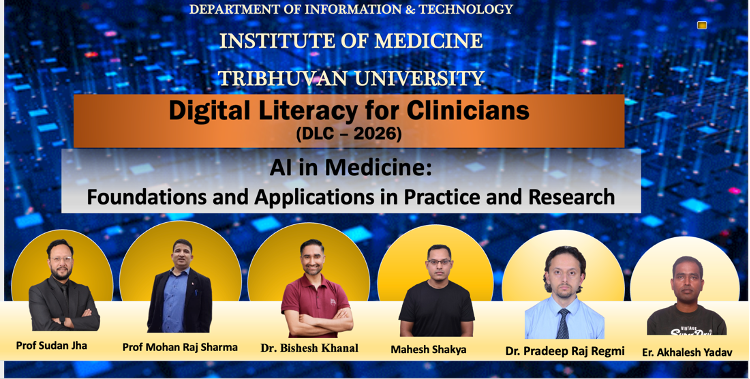
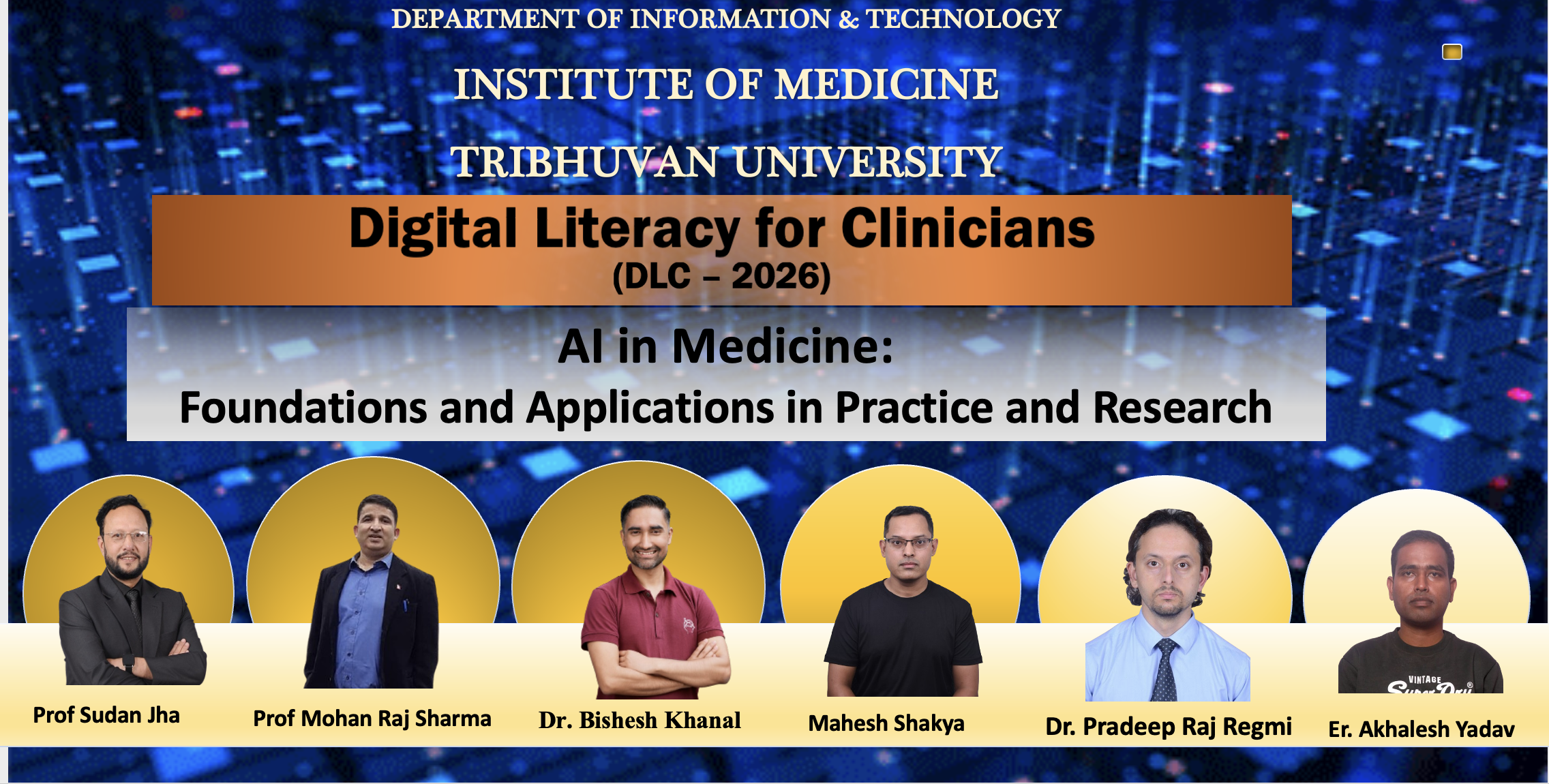
In a significant step toward modernizing medical education and practice, the Department of Information Technology at Maharajgunj Medical Campus successfully organized a program titled "The Augmented Clinician: Integrating AI into Clinical & Academic Workflows." The event was held as a key component of the "Digital Literacy for Clinicians 2026" initiative, underscoring the institution's commitment to preparing healthcare professionals for a technology-driven future.
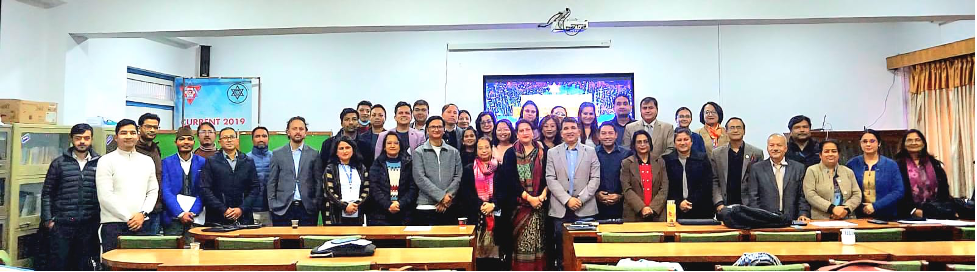
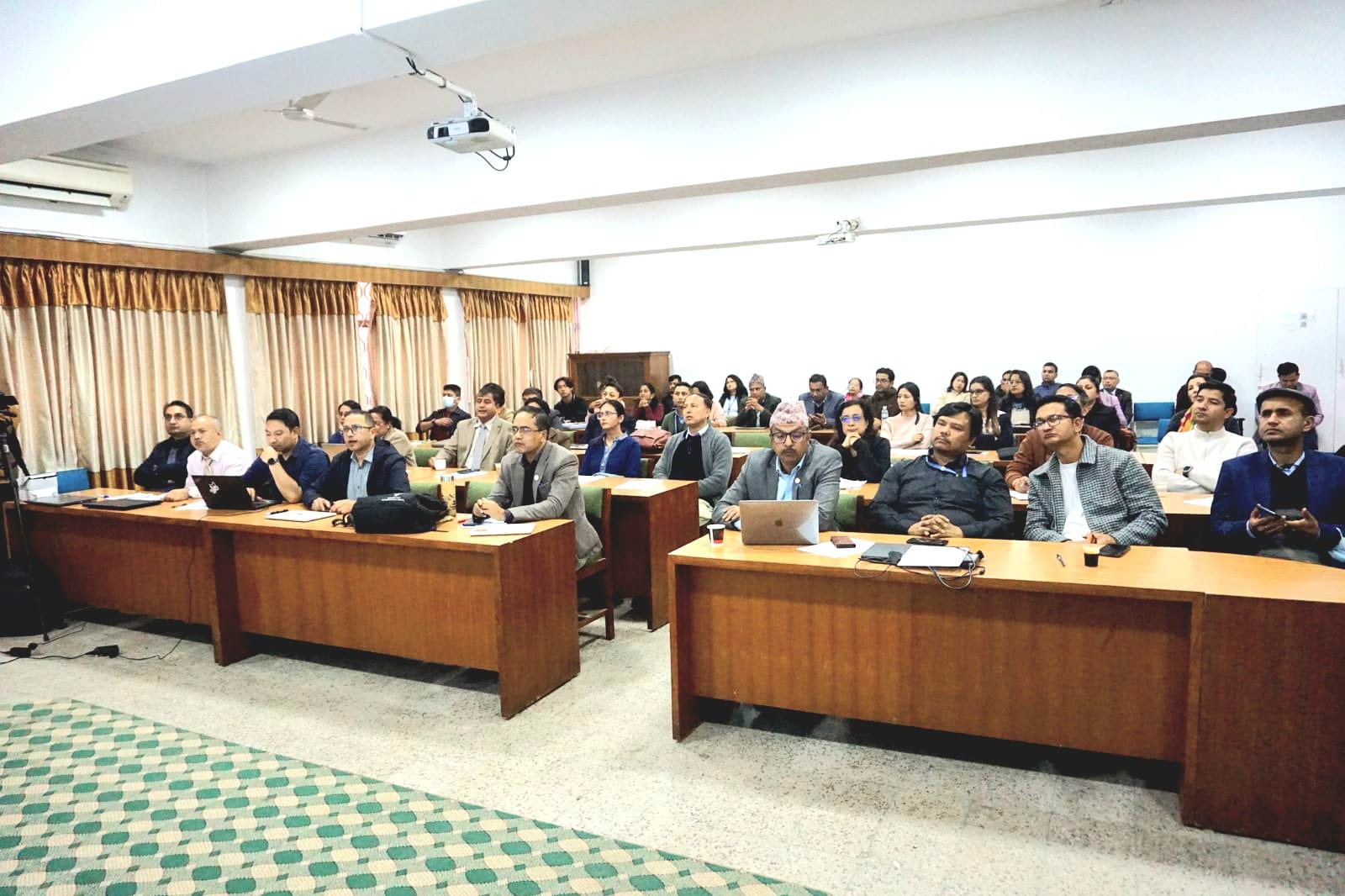
The program witnessed an impressive interdisciplinary turnout, with 65 participants in attendance. The audience comprised faculty and staff from all 38 departments of the Maharajgunj Medical Campus, alongside distinguished representatives from the Nursing Campus and KIST Medical College, highlighting a campus-wide and cross-institutional interest in the intersection of healthcare and artificial intelligence.
The session brought together a panel of esteemed experts who delved into the multifaceted role of AI in modern medicine, from foundational concepts to advanced clinical applications.
Dr. Bikal Ghimire, Head of the Department of Information Technology, delivered the welcome address, setting the stage for a day of intensive learning and collaboration. He emphasized the critical need for clinicians to understand and leverage AI tools to enhance patient care and academic rigor.
The scientific session commenced with Mr. Mahesh Shakya presenting on the "Evolution of AI and its taxonomy/foundation." His session served as a primer, tracing the journey of AI from its conceptual origins to its current state. He clarified key terminologies and classifications within AI, such as machine learning, deep learning, and neural networks, equipping the attendees with the basic literacy needed to navigate more advanced topics.
To provide a foundational understanding of the field and its application, Prof. Sudan Jha, who presented on "The AI-Augmented Physician: From Classroom to Clinic, AI in Teaching and Learning." Prof. Jha explored how artificial intelligence is transforming medical education by personalizing learning experiences, simulating complex clinical scenarios, and providing intelligent tutoring systems. He painted a picture of the future physician who uses AI not as a replacement, but as a powerful partner in both learning and clinical decision-making.
Prof. Mohan Sharma captivated the audience with his talk, "Beyond Chat GPT: How Large Language Models (LLMs) work in a medical context." Prof. Sharma demystified the technology behind LLMs, explaining their inner workings and their vast potential in healthcare. He discussed applications ranging from automating clinical documentation and summarizing patient histories to assisting with differential diagnoses and providing up-to-date medical literature reviews, all while cautioning about the importance of data privacy and accuracy.
A highlight of the program was the presentation by Dr. Bishesh Khanal on "Uses of Artificial Intelligence in Nepal (Current status from NAMMI)." Dr. Khanal, a leading figure in the field, provided a realistic and inspiring overview of how AI is being applied within the Nepali healthcare context. He shared ongoing projects and research from NAMMI, demonstrating local solutions for local challenges, particularly in medical imaging and diagnostics, and showcasing Nepal's growing footprint in the global AI landscape.
The program also featured a critical perspective on the digital transformation of healthcare from Dr. Pradeep Raj Regmi, a respected radiologist faculty member at Maharajgunj Medical Campus. Dr. Regmi, who specializes in the delicate fields of pediatric and fetal imaging, is currently enhancing his expertise as a Postgraduate Scholar in Artificial Intelligence and Machine Learning from the University of Texas.
Bringing his unique perspective as both a clinician and an AI scholar, Dr. Regmi addressed the audience on the topic of "Ethics in Artificial Intelligence in Medicine." His presentation served as a crucial counterbalance to the technological enthusiasm of the day, delving into the moral responsibilities that accompany the adoption of AI in healthcare. Dr. Regmi drew upon his frontline experience to discuss the ethical challenges specific to the Nepali healthcare landscape. He highlighted concerns regarding data privacy, algorithmic bias, and the importance of maintaining human oversight in diagnostic processes—particularly in the high-stakes areas of pediatric and fetal radiology where he practices.
Furthermore, Dr. Regmi shared insights into his ongoing work, noting that he is actively engaged in multiple AI in radiology projects within his department. These initiatives are being conducted in close collaboration with various hospitals across Nepal and NAAMII (Nepal Applied Mathematics and Informatics Institute for research), demonstrating a strong commitment to developing context-aware, locally relevant AI solutions. His talk underscored that as Nepal moves toward an AI-augmented future, it must do so with a strong ethical framework to ensure technology serves all patients equitably.
The technological frontier was further explored by Er. Akhalesh Yadav, whose topic, "Robotics and Artificial Intelligence, Medical robotics, AI-driven healthcare solutions, and intelligent automation," looked toward the future. Er. Yadav discussed the convergence of robotics and AI, illustrating how intelligent automation is revolutionizing surgery, rehabilitation, and hospital logistics. He provided insights into how robotic systems, guided by AI, can enhance precision and improve patient outcomes.
Following the insightful presentations, the formal session concluded with a vote of thanks from Dr. Lava Shrestha, Course Coordinator. Dr. Shrestha expressed his gratitude to the distinguished speakers for sharing their expertise and to the participants for their enthusiastic engagement, which made the program a resounding success. He reiterated the department's dedication to fostering digital literacy and encouraging interdisciplinary dialogue to shape the next generation of healthcare in Nepal.
The "Augmented Clinician" program marks a pivotal moment in the academic calendar of Maharajgunj Medical Campus, fostering a collaborative environment where medicine and technology converge to chart the future of healthcare.